
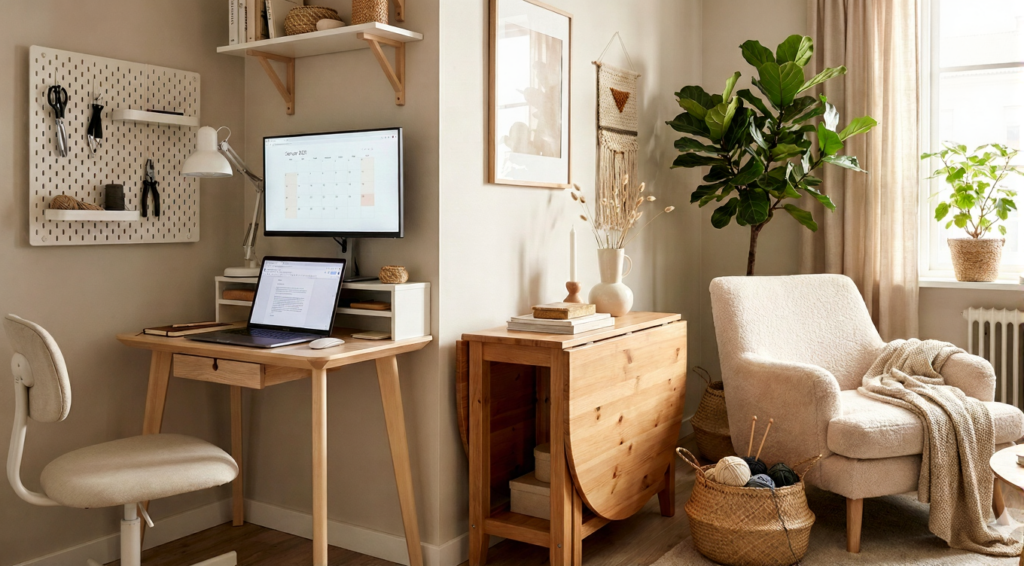
How to Balance Your Home Passion & Work in a Small Space
So, you’re currently working from a desk that also happens to be your dinner table, your hobby station, and if we’re being honest, a temporary landing pad for junk mail. I know that feeling all too well.
Living in a small space often feels like playing a high-stakes game of Tetris where the prize is just being able to find your stapler. When your “office” is three feet away from your “sanctuary,” the lines get blurry fast.
I spent an entire year running a business from a studio apartment where my bed was technically my office chair. Trust me, nothing kills your passion & work drive faster than staring at a pile of unwashed dishes while you’re trying to close a deal.
But you don’t need a mansion to find balance. You just need to stop fighting your floor plan and start outsmarting it. Ready to reclaim your sanity? Let’s fix your small space setup once and for all.
Define Your Zones (Even the Invisible Ones)
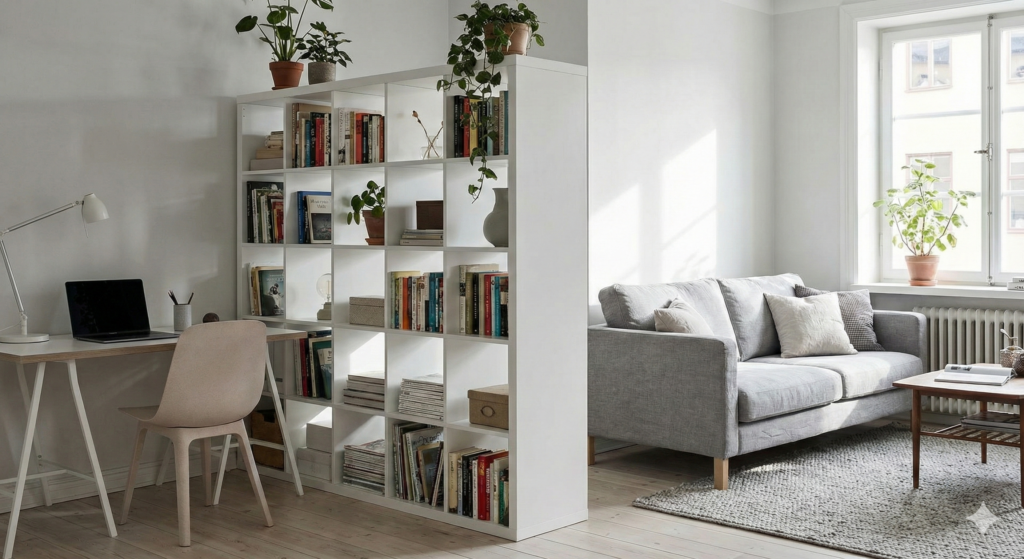
If you take away nothing else today, remember this: Your brain needs boundaries. When you work, eat, and relax in the exact same square footage, your mind never truly “clocks out.”
Ever wondered why you feel restless even when you’re technically relaxing? It’s because your brain still sees the laptop in the corner of its eye. You need to create physical and mental zones that separate your professional life from your personal hobbies.
The Power of Visual Dividers
You don’t need to build walls to create a separate room. In a small space, we use “visual cues” to tell our brains what mode we are in.
- Rugs: Use a small area rug to “anchor” your workspace. When your feet are on that rug, you are at work. When you step off, you are at home.
- Screens and Bookshelves: A tall, open bookshelf like the IKEA Kallax makes a great room divider.1 It lets light through but still creates a definite physical barrier.
- Lighting: Use a specific desk lamp only during work hours. When the “work light” goes off and the “mood lighting” comes on, the workday is officially over.
The “Closed Door” Illusion
What if you don’t even have a corner to spare? Then you look for a “cloffice”, a closet turned office.
I once turned a tiny reach-in closet into a fully functional workspace. I loved this feature because at 5:00 PM, I literally closed the closet door. Out of sight, out of mind. IMO, being able to physically hide your work is the ultimate small-space luxury. 🙂
Verticality is Your Best Friend
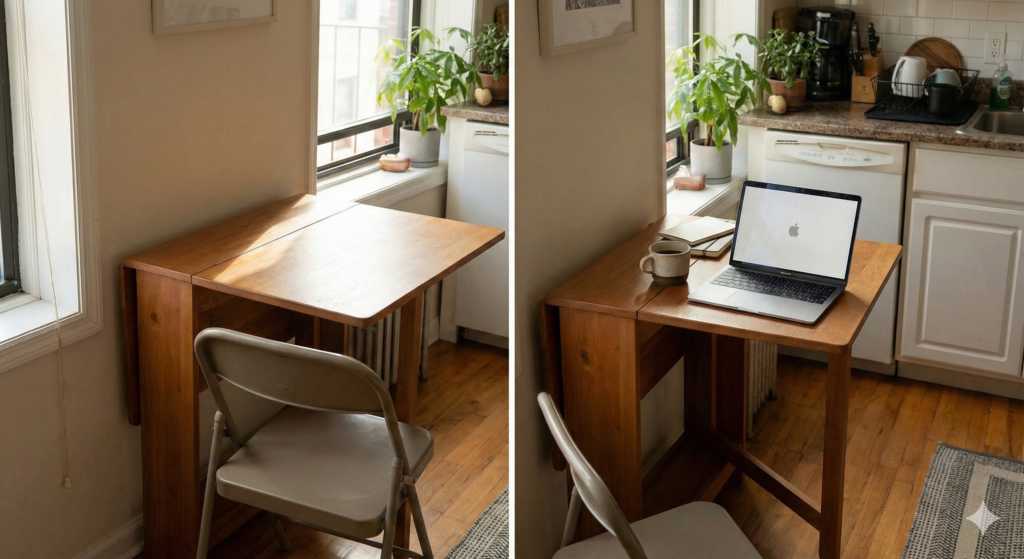
When you run out of floor space, look up. Most people leave the top 30% of their walls completely empty. That is prime real estate for your home passion projects and office supplies.
We often clutter our desks with things that could easily live on the wall. If your desk is smaller than a pizza box, every square inch counts. You need to get your gear off the surface and into the air.
Pegboards and Floating Shelves
The pegboard is the undisputed king of small-space organization. It is completely customizable and holds everything from scissors to headphones.
- Pegboards: Mount one above your desk to keep your most-used tools within arm’s reach. It keeps your workspace clear and looks like a curated art piece.
- Floating Shelves: Install shelves all the way to the ceiling. Put the stuff you use every day at eye level and the stuff you use once a month at the very top.
- Wall-Mounted Monitors: Use a monitor arm to lift your screen off the desk. This frees up space for your keyboard or your sketchbook underneath.
FYI, a clear desk actually reduces cortisol levels.2 When you see a clean surface, you feel in control. When you see a mountain of tangled cords and loose pens, your brain enters panic mode.
Multitasking Furniture: The Real MVP
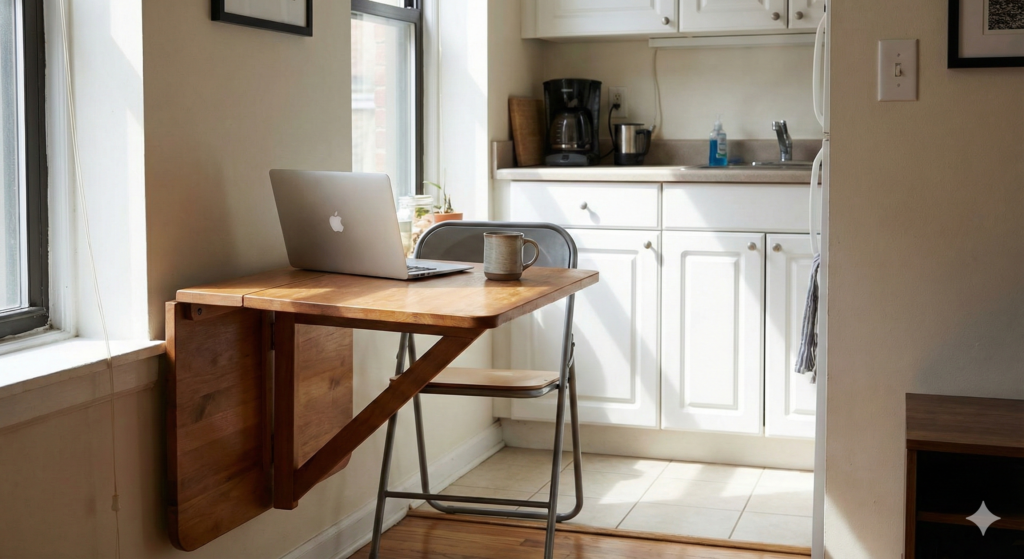
In a small space, every piece of furniture must earn its keep. If a table only does one thing, it’s taking up too much room.
You want pieces that transform based on your needs. I prioritize flexibility over everything else when I’m shopping for small apartments. If it doesn’t fold, nest, or hide, it’s a “no” from me.
Top Furniture Picks for Small Spaces
| Furniture Type | Why It Works | Best For |
| Drop-Leaf Table | It expands when you need a huge workspace and shrinks when you want to eat dinner. | Crafting and Hobbies |
| Storage Ottomans | They provide seating but hide your messy cables or knitting supplies inside. | Hidden Storage |
| Laptop Stand | It turns a kitchen counter or a dresser into a standing desk in seconds. | Ergonomics |
| Rolling Carts | You can wheel your “office” into a closet when the weekend hits. | Ultimate Flexibility |
I use a rolling three-tier cart for all my photography gear. During the week, it sits next to my desk. On Friday evening, I wheel it into the laundry nook. This feature changes everything because it physically removes the “work” from my living space.
The “End of Day” Ritual
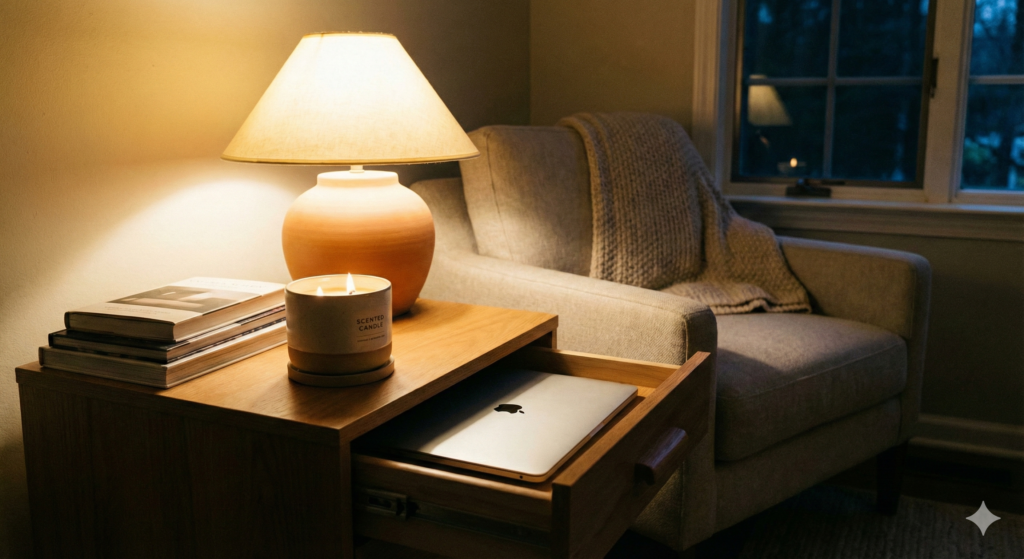
In a small space, your “commute” is about five steps. That’s not enough time for your brain to transition from “Powerpoint Wizard” to “Relaxed Human Being.”
You have to create an intentional ritual to signal the end of the workday. Without a ritual, you’ll find yourself checking emails at 9:00 PM just because the computer is right there staring at you. :/
How to “Shut Down” Properly
This takes five minutes but saves your entire evening.
- Clear the Deck: Put all your pens, notebooks, and loose papers away. If you don’t have a drawer, put them in a decorative basket.
- Close the Tabs: Close every work-related window on your computer. Better yet, shut the computer down entirely.
- The Digital Handover: Put your work phone in a designated “parking spot” (like a drawer or a charging station in another room).
- Scent Cues: Light a specific candle or start a diffuser that you only use for relaxation time.
Ever tried using scent to trigger a mood? It sounds a bit “woo-woo,” but it actually works. Your brain associates that lavender or sandalwood scent with “home time,” making it much easier to flip the switch.
Managing the “Passion” Mess
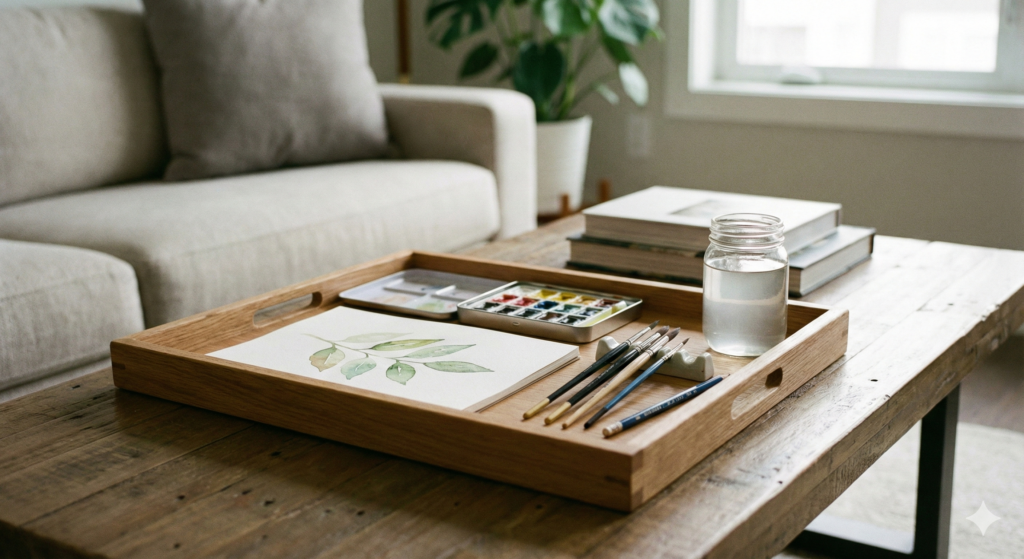
Let’s talk about your hobbies. Whether you’re into painting, 3D printing, or competitive sourdough baking, passions usually involve stuff. And stuff takes up space.
When you balance your home passion with your work, the hobby stuff often wins the clutter war. You need a system that allows you to start and stop your hobby without leaving a permanent disaster zone on your dining table.
Project Trays and Bins
Never leave a half-finished project just sitting out on a surface. Use project trays instead.
If you’re working on a puzzle or a model kit, do it on a large tray. When you need the table for work (or, you know, eating), you just pick up the tray and slide it under the couch. I love this method because it preserves your progress without sacrificing your floor space.
- Clear Bins: Use clear, stackable bins for your supplies. Seeing exactly what’s inside saves you from digging through five different boxes to find one tube of glue.
- Label Everything: Use a label maker. It feels a bit over-the-top, but it prevents that “where did I put that?” spiral that eats up your free time.
Lighting and Air: The Forgotten Essentials
Small spaces get stuffy fast. If you’re working and “passion-ing” in the same 200 square feet all day, the air quality and lighting will affect your mood more than you realize.
H3: Lighting for Different Mindsets
You need layered lighting. One big, bright overhead light makes everything feel like a sterile hospital wing.
- Work Lighting: Use cool-toned, bright LED lights. These keep you alert and focused.
- Passion/Relax Lighting: Use warm-toned lamps and fairy lights. These create a “cozy” atmosphere that feels distinct from your “office.”
FYI, try to position your desk near a window if possible. Natural light regulates your circadian rhythm, which helps you sleep better, even if your bed is only five feet away from your monitor.3
Conclusion: Making Space for Everything
Balancing passion & work in a small space isn’t about having more room; it’s about being more intentional with the room you have. You deserve a home that works as hard as you do and relaxes as deeply as you need to.
By creating zones, utilizing your walls, and sticking to a shutdown ritual, you turn a cramped apartment into a high-functioning sanctuary. You stop being a victim of your square footage and start being the architect of your own environment.
Now, go clear that “everything table” and give your laptop a proper home. Your brain and your dinner will thank you. Would you like me to help you create a specific floor plan or a shopping list for your small-space transition? 🙂